


Page 145 - Demo
P. 145
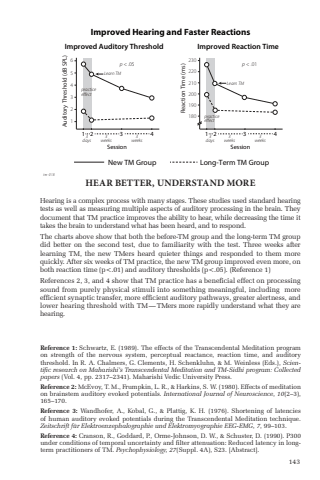
143Hearing is a complex process with many stages. These studies used standard hearing tests as well as measuring multiple aspects of auditory processing in the brain. They document that TM practice improves the ability to hear, while decreasing the time it takes the brain to understand what has been heard, and to respond. The charts above show that both the before-TM group and the long-term TM group did better on the second test, due to familiarity with the test. Three weeks after learning TM, the new TMers heard quieter things and responded to them more quickly. After six weeks of TM practice, the new TM group improved even more, on both reaction time (p<.01) and auditory thresholds (p<.05). (Reference 1)References 2, 3, and 4 show that TM practice has a benefi cial effect on processing sound from purely physical stimuli into something meaningful, including more effi cient synaptic transfer, more effi cient auditory pathways, greater alertness, and lower hearing threshold with TM %u2014 TMers more rapidly understand what they are hearing.654321Auditory Threshold (dB SPL)Improved Hearing and Faster Reactions230220210200190180Reaction Time (ms)p < .05practiceefiectpracticeefiectp < .01New TM Group Long-Term TM GroupImproved Auditory Threshold Improved Reaction Time1 2 3 4Session3 weeks 3days 3 weeks1 2 3 4Session3 weeks 3days 3 weeksLearn TMLearn TMtm-018HEAR BETTER, UNDERSTAND MOREReference 1: Schwartz, E. (1989). The effects of the Transcendental Meditation program on strength of the nervous system, perceptual reactance, reaction time, and auditory threshold. In R. A. Chalmers, G. Clements, H. Schenkluhn, & M. Weinless (Eds.), Scientifi c research on Maharishi%u2019s Transcendental Meditation and TM-Sidhi program: Collected papers (Vol. 4, pp. 2317%u20132341). Maharishi Vedic University Press.Reference 2: McEvoy, T. M., Frumpkin, L. R., & Harkins, S. W. (1980). Effects of meditation on brainstem auditory evoked potentials. International Journal of Neuroscience, 10(2%u20133), 165%u2013170.Reference 3: Wandhofer, A., Kobal, G., & Plattig, K. H. (1976). Shortening of latencies of human auditory evoked potentials during the Transcendental Meditation technique. Zeitschrift f%u00fcr Elektroenzephalographie und Elektromyographie EEG-EMG, 7, 99%u2013103.Reference 4: Cranson, R., Goddard, P., Orme-Johnson, D. W., & Schuster, D. (1990). P300 under conditions of temporal uncertainty and fi lter attenuation: Reduced latency in longterm practitioners of TM. Psychophysiology, 27(Suppl. 4A), S23. [Abstract].


