


Page 153 - Demo
P. 153
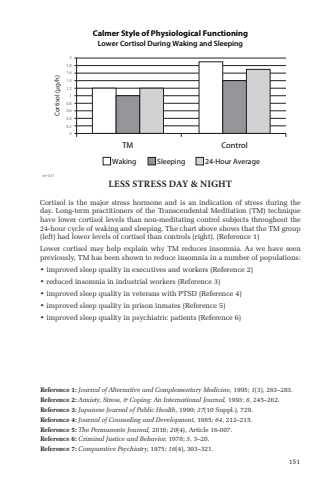
151Cortisol is the major stress hormone and is an indication of stress during the day. Long-term practitioners of the Transcendental Meditation (TM) technique have lower cortisol levels than non-meditating control subjects throughout the 24-hour cycle of waking and sleeping. The chart above shows that the TM group (left) had lower levels of cortisol than controls (right). (Reference 1) Lower cortisol may help explain why TM reduces insomnia. As we have seen previously, TM has been shown to reduce insomnia in a number of populations:%u2022 improved sleep quality in executives and workers (Reference 2)%u2022 reduced insomnia in industrial workers (Reference 3)%u2022 improved sleep quality in veterans with PTSD (Reference 4)%u2022 improved sleep quality in prison inmates (Reference 5)%u2022 improved sleep quality in psychiatric patients (Reference 6)Calmer Style of Physiological Functioning21.81.61.41.210.80.60.40.20TM ControlCortisol (%u03bcg/h)Waking Sleeping 24-Hour AverageLower Cortisol During Waking and Sleepingtm-023LESS STRESS DAY & NIGHTReference 1: Journal of Alternative and Complementary Medicine, 1995; 1(3), 263%u2013283.Reference 2: Anxiety, Stress, & Coping: An International Journal, 1993; 6, 245%u2013262.Reference 3: Japanese Journal of Public Health, 1990; 37(10 Suppl.), 729.Reference 4: Journal of Counseling and Development, 1985; 64, 212%u2013215.Reference 5: The Permanente Journal, 2016; 20(4), Article 16-007. Reference 6: Criminal Justice and Behavior, 1978; 5, 3%u201320.Reference 7: Comparative Psychiatry, 1975; 16(4), 303%u2013321.


